Huddersfield and the surrounding communities have a much deeper wrestling heritage than is sometimes recognised. Long before the modern popularity of Brazilian Jiu-Jitsu, MMA and professional wrestling, wrestling matches were major local attractions, drawing crowds to fields, race grounds and community gatherings throughout the district.
One particularly interesting connection comes through the tradition of the Longwood Thump, while contemporary newspaper reports provide evidence that competitive wrestling was taking place across the surrounding villages of Huddersfield and Holmfirth during the nineteenth century.
Wrestling at Honley Moor
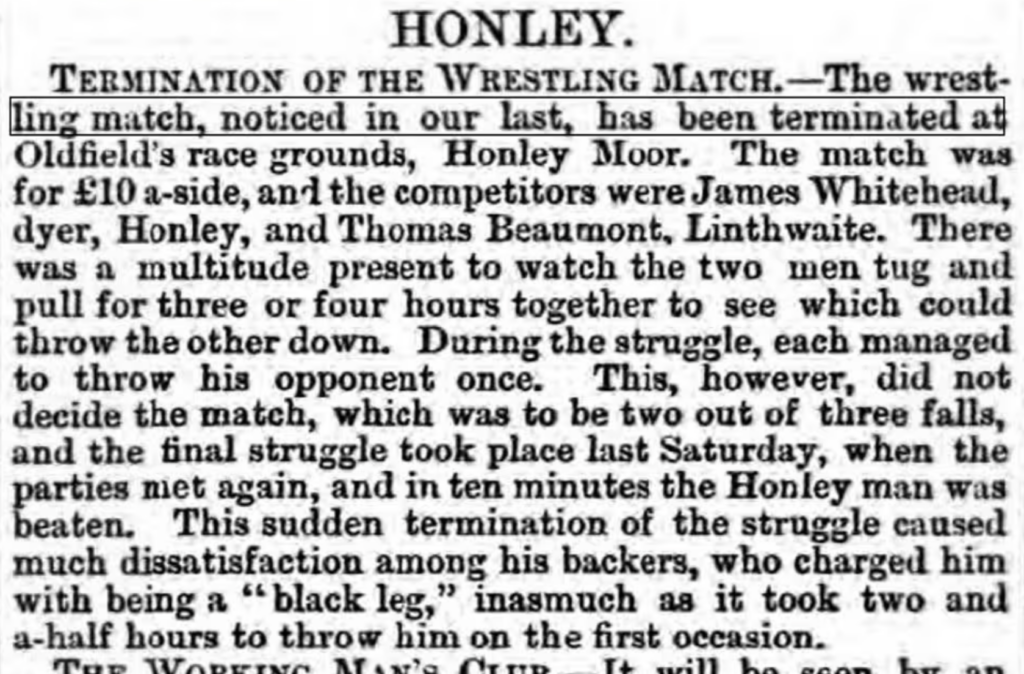
An old newspaper report headed “HONLEY – TERMINATION OF THE WRESTLING MATCH” provides a fascinating glimpse into the wrestling culture of the area.
The report describes a wrestling match held at Oldfield’s race grounds, Honley Moor, contested for £10 a side. The competitors were named as James Whitehead of Honley and Thomas Beaumont of Linthwaite.
The match appears to have been a serious and closely contested affair. According to the report, a multitude of spectators gathered to watch the two men “tug and pull” for three or four hours, each trying to throw the other.
Remarkably, during this initial struggle, both men managed to throw their opponent once. The result therefore remained undecided because the contest was being fought on a best-of-three falls basis.
The final encounter took place the following Saturday. On this occasion, however, the contest was dramatically shorter. The newspaper reported that after approximately ten minutes, the Honley wrestler was defeated.
The result apparently caused considerable dissatisfaction among Whitehead’s supporters. Having taken two and a half hours to throw Beaumont during the first encounter, the suddenness of the final defeat led some of his backers to accuse him of being a “black leg” — nineteenth-century terminology suggesting that they believed the contest had not been honestly fought.
The report is particularly valuable because it demonstrates that wrestling in the Huddersfield district was not simply an informal pastime. Matches could involve substantial sums of money, organised contests, repeat bouts and large crowds of spectators.
It also shows the geographical spread of local wrestling. Whitehead represented Honley, while Beaumont came from nearby Linthwaite, illustrating how wrestling could bring competitors from neighbouring communities together.
The Longwood connection
This tradition of local wrestling fits into the wider culture surrounding Longwood and the Longwood Thump.
Longwood had its own distinctive annual celebrations, known as the Longwood Thump. These festivities were part of a much wider tradition of northern English communal celebrations involving entertainment, music, dancing and physical contests.
The later use of the name Longwood Thump for a wrestling competition reflects the way traditional northern customs and wrestling became intertwined.
Although the later Longwood Thump wrestling competition was associated with the Saddleworth Rushcart rather than taking place in Longwood itself, the name connected it with this older tradition of northern folk culture.
A regional wrestling culture
The Honley newspaper report is important because it places wrestling firmly within the everyday culture of the Huddersfield area.
Honley, Linthwaite, Longwood and the surrounding villages were communities in which wrestling could attract considerable public interest. A match could last for hours, be fought over several meetings and involve enough money and local pride to generate controversy when the result was disputed.
This was not modern competitive wrestling as we know it today. These contests belonged to the broad tradition of British folk wrestling, including the various Lancashire and northern styles that developed across the region.
The emphasis was on physical strength, balance, leverage, gripping and the ability to throw an opponent. The basic objective was simple: put your opponent on the ground while remaining on your feet.
The Honley contest gives us an especially vivid picture of this style of wrestling. Two men physically battling for hours, each managing to score a throw, demonstrates just how demanding these matches could be.
From folk wrestling to modern grappling
The wrestling traditions of Yorkshire and Lancashire form an important part of Britain’s wider combat-sport heritage.
Modern grappling arts may use different terminology and rules, but many of the fundamental principles remain familiar: controlling an opponent’s balance, obtaining advantageous grips, using leverage rather than simply strength, taking an opponent to the ground and maintaining positional control.
For Huddersfield, these old reports provide evidence that wrestling has a genuine local history stretching back well before the emergence of modern combat sports.
The story of James Whitehead of Honley and Thomas Beaumont of Linthwaite is therefore more than an interesting newspaper report. It gives us a glimpse into a time when wrestling matches were local spectacles, when competitors represented their own communities, and when a contest on Honley Moor could keep a crowd watching for hours.
Combined with the later tradition of the Longwood Thump, it forms part of a fascinating picture of northern England’s wrestling heritage.
Today, wrestling and grappling are once again popular throughout Huddersfield. Modern practitioners may train in wrestling rooms, MMA gyms and martial-arts academies rather than on village race grounds, but the underlying principles remain remarkably familiar.
The old wrestlers of Honley and Linthwaite were part of a tradition that deserves to be remembered — a tradition in which wrestling was not merely a sport, but a community spectacle, a test of physical ability and a source of local pride.
And perhaps that is the most interesting part of the Longwood Thump story: the wrestling heritage of Huddersfield did not begin with modern MMA or imported combat sports. The region already had its own wrestling tradition, deeply rooted in the communities, fairs and fields of West Yorkshire.